The Art of the Zhuzh
By Bonnie Fishman / San Francisco Bay Area


I first heard the word “zhuzh” back in 2003 on Queer Eye for the Straight Guy, a TV program on which five gay men who specialized in fashion, home decor, food, grooming and culture offered advice for heterosexual men. It was a most entertaining series, watching the experts zhuzh this and zhuzh that.
Zhuzh (rhymes with “whoosh.”) means “to make something more interesting or attractive by changing it slightly or adding something to it,” according to the Cambridge Dictionary. Less formally, it means to make something peppier, brighter or more balanced. The word had its origin in the British gay community in the 1970s.
Unbeknownst to me, I’ve been zhuzhing my whole culinary career. I just never had a word for it. My first exposure to zhuzhing food happened at the Cordon Bleu Cooking School in London in 1975. The instructors were going around the room that day, sampling everyone’s minestrone. When they stopped and tasted mine, they said it had an excellent touch of salt and pepper. I had zhuzhed the flavors perfectly!
Salt and pepper can make all the difference in the world when cooking. Just because I emphasize these doesn’t mean I’m looking to make a dish salty or spicy. Salt in particular brings out the inherent flavors of food. I really notice this in a salad or the dressing for that matter. Without the proper harmony, the taste can fall flat. I make salad for lunch almost every day. When I’m finishing the preparation, I add an extra squeeze of lemon or a sprinkle of sea salt or a grind of pepper to get the right equilibrium of flavors. I often mix in arugula with the lettuce to achieve that bitter taste. Lastly, I’ll add fruit–oranges, strawberries, apples, or raisins–to give it sweetness.
I just love watching judges on Top Chef comment on, say, a fish sauce and declare that “the dish needs more brightness (zhuzh), like citrus.” They’re looking for balance of the five basic tastes: sweet, sour, salt, bitter and umami. According to the Cordon Bleu website: "Umami can be hard to pin down, but it’s the inherent savory notes in soy sauce, mushrooms, oysters and many cheeses.” Think of umami as “earthy,” These five flavors can appear in a single meal.
The ultimate zhuzh for food, in my opinion, would have to be edible gold leaf, something I never really explored before I had the good fortune to meet Lynn Neuberg of Los Angeles. She is one of the largest wholesalers of edible gold in North America. In fact, Lynn has been credited with bringing it into the 21st century. Sur la Table was her first retailer, Wolfgang Puck used her gold at the Academy Awards Governor’s Ball in 2003, and she was featured in House & Garden magazine. Her business took off from there. You can see Lynn’s products at easyleafproductsfood.nnigroup.com.

Gold was very popular during the Renaissance when presented in a meal. It was a sign of respect to guests and, of course, wealth. Lynn tells me that the gold now is used to enhance the appearance of cocktails as much as it is to garnish food. It comes in sheets, leaves, or dusting powder. Gold can only be consumed if it’s 23 or 24 carats. This grade passes through your digestive system without any harm. Lesser carats have other alloys which may be detrimental to the body.


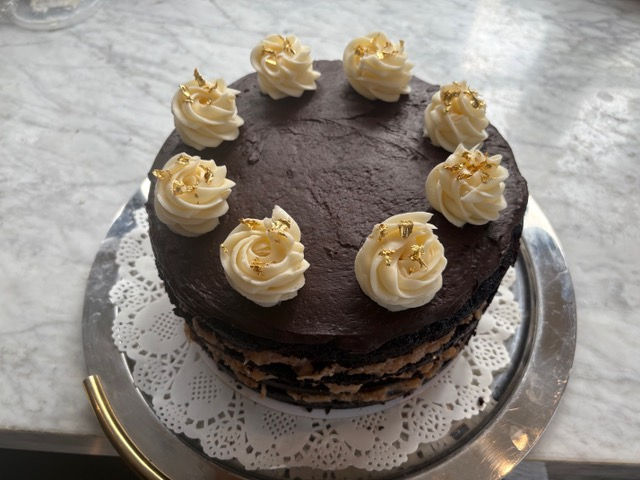
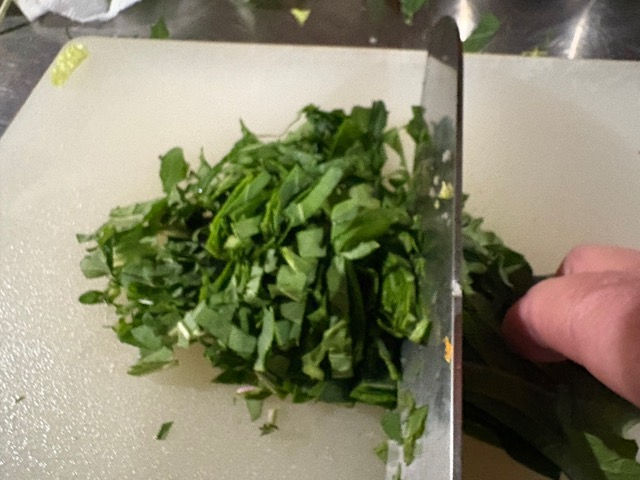
I personally zhuzh on a more pedestrian level. For dessert or some fruit tray, I might garnish with fanned strawberries. For savory dishes, a sprinkle of chopped parsley on a bowl of soup or pasta brings the visuals to life. Flavor-wise, tasting is the best way to know what’s missing, if anything. Does it need more acid, or heat, or salt? The slightest tweak can make all the difference in the world. “Tweezer” foods create the ultimate zhuzh. These are fancier dishes where tweezers are used for delicate garnish or ingredient applications.


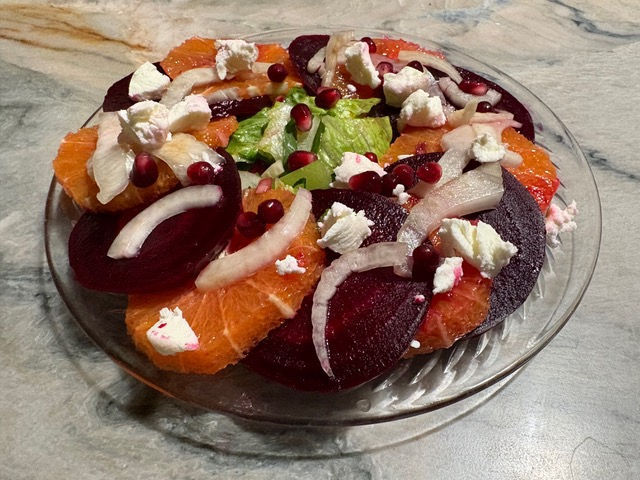
The recipe for today, Orange and Beet Salad with Pickled Fennel, is a great example of zhuzhing both visually and taste-wise. The dish has sweet, sour, salt, and heat. The sweet comes from the beets and oranges. The sour comes from an acidic dressing and pickled fennel. The heat comes from peppery arugula and fresh ground black pepper. We get salt from both the goat cheese and proper seasoning.
Decoratively, the food is arranged in a pretty pattern with tossed arugula in the center. The top is garnished with the fennel and crumbled goat cheese on top. Let’s “gild the lily” here and add pomegranate seeds. This cheerful salad is great served on a brunch or lunch buffet or as a starter salad at dinner when plated on individual plates. Zhuzh away!
Beet Orange Salad with Pickled Fennel
Yield: 6-8 servings

Salad:
4 medium beets, (@ 1 1/2 lbs.)
6 Cara Cara or navel oranges
4 cups 1/2” thick sliced romaine lettuce (crosswise)
2 c. finely shredded arugula
3-4 oz. goat or feta cheese
1/3 c. pomegranate seed
Pickled Fennel:
1 fennel bulb, stalks and core removed, cut in half top to bottom, slice thin
1/2 c. rice vinegar
1/2 c. water
1/2 c. sugar
1 garlic clove, peeled and sliced
1/4 tsp. fennel seeds
1/8 tsp. black peppercorns
1/8 tsp. yellow mustard seeds
Citrus Dressing:
2 Tbsp. grated orange zest
2 Tbsp. grated lemon zest
1/4 c. fresh lemon juice
1/2 c. extra virgin olive oil
1 tsp. coarse ground black pepper
1/2 tsp. salt
Make dressing: Put all ingredients in a clean jar. Shake well before mixing with the salad greens. Moisten the lettuce. Save the rest for another use.
Pickle fennel: Put the pickling ingredients in a 2-quart saucepan. Boil for 3 minutes. Remove from heat. Mix in fennel until completely submerged. Cool completely, about 30 minutes. Store in a clean glass jar in the fridge.
Beets: Cover with salted water in a saucepan. Boil until tender, about 45 minutes. When cool, cut the stem and root ends off, then peel. Slice beets into 1/8” circles.
Oranges: Remove the rind and pith from the oranges. Slice into 1/4” circles.
Assemble: On a large flat platter or individual salad plates, line the dishes with lettuce. Arrange the beets and oranges around in concentric circles, overlapping evenly. Scatter some fennel on top of the beets and oranges. Put some fennel in the middle of the plate. Crumble the cheese and distribute on the fennel. Sprinkle with pomegranate seeds.




Bonnie Fishman attended the Cordon Bleu Cookery School in London. Later, she owned and operated Bonnie’s Patisserie in Southfield, Mich. and Bonnie’s Kitchen and Catering in Bloomfield Hills, Mich. She has taught cooking for over 35 years and created hundreds of recipes. She is now living in Northern California.
Comments