Let's Roll With It!
Updated: Jul 28
By Bonnie Fishman / San Francisco Bay Area


Things have come a long way since 1762, when the Earl of Sandwich became very famous for putting meat between two pieces of bread. Why did he do this? Apparently, the Earl was a heavy gambler. Having the sandwich close by, he could eat and play cards at the same time. Efficient, no?
Sandwiches today have become a convenience food, portability being the most important characteristic for multi-tasking: eating at one’s desk while still being able to work, drive and eat at the same time, tailgating or picnics.
Wraps or rolled sandwiches can be made with tortillas, lavashes or pitas, with fillings such as sliced deli meats chicken salad or hummus with lettuce, tomatoes and cucumbers. They began appearing in restaurants during the ‘80s, inspired by California, where the influence of Tex-Mex food had popularized burritos.
Let’s take a step back in time to the ’50s and ’60s when sandwiches took on a different form. Homemakers would make petite tea sandwiches for luncheons and, well, teas. A really fun snack was when they would roll out bread to flatten it, spread on cream cheese and something like cucumbers or radishes, roll them up and make pinwheels. I remember my mom doing this. I found it fascinating that you could make the bread thin enough to create a dainty and delicious treat.
In the mid-70s, I had a Proustian food experience. Do you ever have a food memory that is so profound you still remember it decades later? It could have been something plain or simple, but the taste and texture just knocked you for a loop. My husband, Bob, and I had traveled to San Francisco for a podiatry conference. Sounds exciting, right? He attended the meetings, but I ran around the city.
I was near Union Square, a major retail hub in the city. I stopped by a lunch spot where they had a carry-out window. I ordered a sandwich made with whole wheat bread (whole wheat products hadn’t really hit the Midwest yet, so this was striking to me), slathered with cream cheese and topped with tomatoes, avocados, and alfalfa sprouts. What a combination! Very California.

The rolled sandwich really took off in the ’90s as a substitute for sandwiches, partly because of the low-carb craze–a wrap uses a lot less bread. They showed up on trays for luncheons, office meetings, and casual parties. The beauty of wraps is that they are often cut in half, so as to give the guest the option of a variety of different fillings, half of this and half of that.
When I had my shops, Bonnie’s Patisserie and Bonnie’s Kitchen, in suburban Detroit from 1980 to 2009, the wrap was a mainstay for office lunches. We made different chicken salads, flank steak fajitas, vegetarian wraps with hummus and grilled vegetables. These roll-ups took little time to prepare.
At my first bakery/gourmet food shop, I created an appetizer that we called California Rolls. I named it after my discovery on the California trip. Little did I know that sushi California rolls were going to nose their way into our food culture 20 years later. It got a little confusing for our customers as to what kind of California rolls they were really buying.
Our California Rolls were used as appetizers. They were by far our biggest seller. Instead of shredded lettuce, we used alfalfa sprouts. Before tortillas and lavashes were popular, I needed to find some bread that we could roll. I ended up with a large Armenian crisp flat bread that we had to soak overnight to make it pliable. What a pain!
Trader Joe’s has saved the day for current cooks. They sell a flexible, soft, thin flatbread that is the right size (8” x 12”) and shape. I use them in this month’s recipe. If you are unable to buy this product, use 2 large flour tortillas for each cracker bread.


Lately, I use finely shredded lettuce in place of sprouts because there has been so much contamination of alfalfa sprouts. Feel free to try different filling combinations. Cream cheese is almost a must for the spread because it becomes stiff when chilled and holds the roll-ups together.
This is a fun appetizer to make, and the recipe can be multiplied many times for large gatherings. Have fun rolling!
Bonnie’s California Rolls
Yield: 24 pieces

2 pieces of soft, thin cracker bread (Trader Joe’s Old-Fashioned Clay Oven-Baked Lavash Flatbread or 4 large flour tortilla wrappers)
8 oz. cream cheese, room temperature
2 Tbsp. thinly sliced scallions
2 shakes hot sauce
1/4 tsp. salt
1 ripe avocado, sliced lengthwise in 6-8 slices
1 medium large Roma tomato, sliced lengthwise into 6 pieces
3/4 c. finely shredded Romaine lettuce, packed
1/4 c. finely shredded arugula
In a medium bowl using a wooden spoon, beat the cream cheese until light and fluffy. Add the scallions, hot sauce, and salt. Combine well.
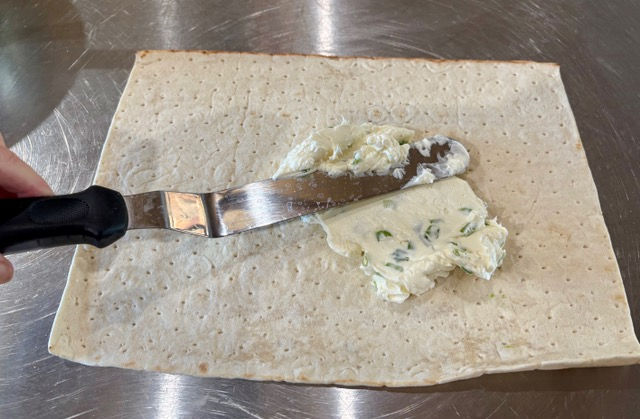
Lay the sheets of lavash on your work surface, with the light side facing up. The long side should face you. Divide the cream cheese mixture between the two pieces. Spread the filling evenly over the lavashes..
Beginning about 2” in from the bottom, line up the avocados end to end. Line up the tomatoes in the same way, lying next to the avocados. Distribute the lettuce and arugula on top of the vegetables.
Roll up the sandwich, starting at the bottom by wrapping the vegetables tightly. Continue rolling until the top end. Tightly wrap each log in cling film. Refrigerate for at least an hour or two to firm up the cream cheese.
Using a sharp knife, trim off the ends. Slice each log evenly into a dozen pieces. Arrange on a tray, cut side up.




Bonnie Fishman attended the Cordon Bleu Cookery School in London. Later, she owned and operated Bonnie’s Patisserie in Southfield, Mich. and Bonnie’s Kitchen and Catering in Bloomfield Hills, Mich. She has taught cooking for over 35 years and created hundreds of recipes. She is now living in Northern California.
Comments